

has been modified so that we can come together safely. Each of us (person or family) will spend most of their time in relationship with a particular part of the land. That may be deep in the woods, up the hill, down by the creek, in the orchard or garden or right near the house. You’re invited to find yourself in that piece of ground, to fall in love with it, to care for it, and to let it nourish and heal you. We’ll come together on the lawn for meals, discussion, and sitting zazen together.
Please look here for more information, and feel free to contact us. With the care around the pandemic, we’ll probably have a lot of advance discussion.
Fees are minimal, only covering outright expenses, yet there could be some work exchange.
Local people are welcome to come out and spend time on the land. You can walk in the meadow, orchard, woods, or by the creeks. If you’d like to do a land care project, you’re most welcome.
Personal visits, unless brief, usually involve working together in the garden or something. It’s a wonderful way to spend an afternoon. (It could involve harvesting, canning, freezing, or whatever we think is safe to do together.)
I’m also interested in hiring some people to do work, which mostly involves either gardening skills, muscles, or chain saws.
For any of these, email is best.
We’re now sitting together in the morning, Monday through Friday at 6 am Central Time (7 Eastern, 5 Mountain, 4 Pacific), and you are invited. Here is detailed information.
Living by Vow: Introductory class Wednesday evenings 6:30-8 pm Central Time, using the text by my teacher Shohaku Okumura. Best way to join is by emailing Shodo.
The Gift of Fearlessness: Sunday evenings at 4-5:15 pm Central Time. This discussion group started in response to the pandemic, and is now also contemplating the uprisings over racism and injustice. Best way to join is by emailing Shodo.
Today is Juneteenth, the anniversary of the freeing of the last slaves in the U.S. South. The Emancipation Proclamation was two and a half years earlier; the South fought on, and after Lee surrendered it still took two months for the news to reach Galveston, Texas. Black people have been celebrating this date ever since.
This year, in sobriety, respect, and hope, many are honoring this day regardless of color.
Sobriety: people who thought racism was in the distant past have been forced to see it alive and well. Despite having achieved perceived milestones in the war against racism like electing a Black president, we have seen the senseless killings of George Floyd, Breanna Taylor, Ahmaud Arbery, Rayshard Brooks and others in under a month’s time, plus hangings of six Black people between May 27 and June 18. And the absurd labeling of the hangings as suicides. And police brutality, finally visible to more than just its victims. Collectively,we are waking up from a dream that things were okay, a dream that Black, Indigenous, or any people of color were not able to join in. White people are looking into racism more deeply than before, probably more than since the early days of Reconstruction.
Respect for the conduct of so many people involved in the protests and memorials. While a few set fires or wave guns, thousands of people gather peacefully, and hundreds provide support services to protesters and to the people whose lives are changed by what’s happening.
And respect for the people from all parts of life, quietly making changes, studying, asking themselves what they can do differently, talking to their neighbors and family. I’m seeing a lot of serious work by people in the facebook “Whiteness and Anti-Racism Learning Group.” And elsewhere. Businesses calling the day off for study and reflection. Organizations dissociating themselves with racism. And respect for all the people who are making their best effort.
Hope: This is personal. I find hope in the creation of community in the midst of disaster, as people meet daily at Powderhorn Park throughout the crisis, as organizations provide food and basic needs, set up medic tents, share information, schedule community patrolling when the police are absent, create ceremony and art and beauty. I say, “This is who we are. We can do this.”

I find hope when the Parks Board declares that its parks are sanctuaries and refuges, open to those activities and to people made homeless one way or another.
Hope when City Council moves to deeply address problems of violence and racism in the department – and the media discuss how social services prevent crime. I find hope when support comes from unexpected places, from mayors taking down Confederate statues to businesses honoring Juneteenth to (seriously!) Popular Mechanics explaining how to safely topple a statue, Forbes running a series of articles against racism.
I find hope in the worldwide response, marches and protests against racism everywhere. I find hope in the media response, naming white supremacists and outside agitators, not immediately assuming they were all Antifa or anarchists.
A vision is forming, of a world in which every person’s dignity is respected, people are safe, and power comes more from people than from guns. It’s an old dream – but it’s shared in a new way, and that gives me hope. It won’t happen naturally; the backlash is visible and loud.
The dream of the Mountains and Waters Alliance names something beyond: “to heal the deep cause of the climate emergency in the rift between the dominant human culture and the whole of life on earth. Together with all beings, we protect and restore the living earth.” While the healing of racism wasn’t specifically named – and that was a mistake – it is inherent in our vision.
Acting with respect
Each of us finds our own way, specific to who we are and where we are. I’m doing these things:
I’m working to be anti-racist because I don’t think nonracism is a real thing. I follow the leadership of people of color. Rather than putting forth my own theories about what is happening, I’m listening closely to people who are actually from the neighborhood, and sharing their words when it seems appropriate. Rather than centering myself, I’m watching and listening while others lead.
 spend some of the day in prayer and ceremony, joining the World Peace and Prayer Day (now through June 21) with Chief Arvol Looking Horse.
May we be at peace. May we find joy in loving each other. May we respect each other’s freedom and dignity. May we find our home in the whole of humanity – and in all of life itself. May we be able to do what is needed, when the time comes. May we have freedom in our hearts.

“Whoever you are, no matter how lonely, the world offers itself to your imagination,
calls to you like the wild geese, harsh and exciting–over and over announcing your place in the family of things.”
Mary Oliver’s words in “Wild Geese” came to me, surprising in this time of violence and burning. The world offers itself to your imagination. The world announces your place in the family of things. Even if it’s not the world we would choose, even if it’s frightening, the world calls to us and offers a place.
People are finding their place, right now, gradually or quickly. Some are offering kindness, some are creating community in the midst of the flames. Some are speaking, analyzing, inspiring. Some see themselves as building a new world, others see themselves as destroying the evils of the old. And I will not deny that the force called wetiko, the cannibal monster that consumes everything, is present and visible.
It was in my old neighborhood that George Floyd was killed. I followed events intensely. I wanted to analyze and write, wanted to offer a total understanding of what is happening here. Finally, after many hours and many pages, I let it go. It’s too soon to say. And others are doing well on offering the bits and pieces of understanding. I’ve assembled as much as possible on my Facebook page. What is being asked of me in these days is to teach Zen, to hold a calm place, and to care for the land. At this moment, the wind blows through the window and disrupts my many pages of notes and writings. I let them go.
Online there is a Zen study group Wednesday evenings, a discussion group Sunday afternoons, and zazen (meditation) Monday mornings. To get current information, email me to join the email announcement group.
Meanwhile, birds call, sun is shining, bean plants are up, strawberries flower, wind moves in the trees. Aware that it is a privilege to live in such a place, I also assert that this is the natural way of being human, to belong to the world. To refuse it would be a crime. To share it is imperative.
While the pandemic is still rising, and the future unknown, I extend some invitations.
And I ask you to do your meditative practices, walk outdoors, practice compassion, be a resource for those around you as the world shifts. The more intense things become, the more we need calm minds and hearts. As we each find our place in the family of things.
Love,
Shodo
P.S. In 2017, I wrote an essay in response to the first summer of wildfires everywhere. I’m including it here, still relevant in the time of these other fires.
The world is literally burning. Flooding. Shaking. Melting. Erupting. The news of summer and fall 2017 has included one disaster after another, in everyone’s back yard, leaving our confidence in normalcy badly shaken.
The climate-caused weather events have put many of us into the state well-known by others for years – decades – centuries. Uncertainty is a way of life; sickness, starvation, and cold or heat threaten. Which reminds me that there have been whole peoples who were at ease with uncertainty. We call them hunter-gatherers, and they have been able to live at ease in places most of us find inhospitable – the Kalahari Desert, the Arctic. (1) The ease comes from not expecting certainty, not demanding even personal survival.
Daniel Quinn (2) writes about peoples who “live in the hands of the gods” versus those who attempt to take control of their surroundings. We live in the latter, even though as Buddhists we are taught impermanence. Impermanence is not not just an idea.
Taking refuge is not an idea either – it has become a vivid reality, especially for those evicted from their homes by wildfires, floods, hurricanes, earthquakes, or wars. What’s new for me is that people I know personally are now among the refugees. Most of them will be okay, at some level, mostly because we live in a rich country and it will spend its resources on them – particularly if they are white and middle-class. Because our country (and others) keep out desperate refugees in order to protect our own people from having to share. Because those who make decisions on our behalf operate from the mind of separation. Eventually the riches will be used up, and we will have to rely on our neighbors.
The choice of Euro-American culture is still what it has been for a long time: to place our faith in our own ability to control nature. We replaced serfs with slaves, then with machines and chemicals – and have poisoned our food and depleted our soils, water, and air, which we regard as lifeless, as resources for human use. To live in this way, disconnected from everything around us, is a tragedy.
Thomas Berry puts it this way: “We are talking only to ourselves. We are not talking to the rivers, we are not listening to the wind and stars. We have broken the great conversation. By breaking that conversation we have shattered the universe. All the disasters that are happening now are a result of that spiritual autism.” (3)
“We have shattered the universe.” That is a strong statement. But the universe that consists of wholeness, of inter-relation, of mutual co-creation – we shatter our experience of that universe, so it becomes ultimate reality but not lived reality.
The broken conversation includes breaking the conversation with each other. We blame each other, which escalates mutual blame makes it impossible to work together. It’s easy enough to notice white supremacists blaming Muslims and calling violence on peaceful African-American protesters. Yet environmentalists too have been separating into camps, accusing each other of being either complicit with the destruction or too aggressive. Those who agree on the situation but have different solutions (veganism versus holistic animal farming, for instance) seem to hate each other worst of all.
We find ourselves divided, alone. It’s the disease of the time. While the human assault on the natural world escalates. While almost none of us are talking with the rivers, trees, and mountains, or listening to them.
I’m learning, or trying to learn, to talk with them again. After two years of persistent effort, my habits have started to include asking for help from the hill. Noticing when I am out of communication. Making offerings to a certain old tree stump at the north gate of the land and to the water spirits of the river, building an altar at the east gate where the creeks come together.
In the spring of 2015 I was pulling up weeds in the orchard, working with Justin Rowland, a Lakota person with a traditional upbringing. He suddenly said “Those plants are very strong over here.” Then he added, “They communicate with each other.” Was my attempt to remove the weeds making them stronger?
I had assumed that if I worked hard enough I could eradicate the problem plants. It never occurred to me that, just as humans form defenses against outside assaults, the plant groups were strengthening themselves against my assault. To think of them as conscious – it changed everything. The question becomes: Can I pull up weeds and also be in conversation with them? If being in conversation comes first, how can I take care of this land – my accepted responsibility – and its many “invasive” plants and animals? How can I not be a victim of plant, animal, and insect bullies?
I had a dream in which there were a hundred people living at my seventeen-acre farm. Although we could possibly feed ourselves by intensive farming plus foraging the woods, there wasn’t enough food to carry us through the winter and spring until harvest. (Nor were there enough deer, squirrels, and rabbits.) It was completely obvious that it would be unfair to favor my own family – four of them were in the dream – and that the only fair thing would be to draw lots for who got the food – who survived. There was no question of my drawing those lots; the hard physical work would require strength I don’t have (said the dream).
I woke shaking. The dream has stayed with me for over a year now. About the children, and one daughter and her husband, there was only grief and faint hope. And yes, in waking life I did bargain with myself about whether I had skills that would be needed, that would get me into the survival lottery. My other daughter’s family, my niece and nephew, and others I loved – they were simply absent from the dream, with no idea whether they were alive or dead.
In the dream, people were thoughtful and respectful, a community working together to find a way to survive. No preference was given for wealth (my ownership of the farm) or status.
I actually think something like this will happen, only it will be harder: there will also be bands of hungry people coming from the cities; some will join us, some will have guns and will be willing to kill in order to eat. It might not happen; I don’t know when if it does, and I may never be ready.
The separate self wants to continue. Always. I may as well be kind to that urge in myself and in others.
There are the four seals of Buddhism. Impermanence, suffering, no-self, nirvana. Not accepting impermanence and no-self leads to suffering. Accepting them leads to nirvana. I wonder how this relates to Quinn’s “living in the hands of the gods.” Quinn’s image is from before civilization saved humans from constant uncertainty. In that earlier time, death was not an unusual thing or a disaster. I imagine it did not hurt any less personally, but the sense of outrage or unfairness might have been different. Since the change, humans have sought refuge in our own power, in our structures, in our ability to store grain – instead of in the offerings of the earth, the kindness of the universe. After 8000 years of agriculture, it’s hard to imagine what that would be like.
Where is refuge? Shohaku Okumura said to me once, in the early days when I was still obsessed with enlightenment, “Enlightenment means you have nothing at all that you can rely on.” (4) I take refuge in this teaching: there is nothing to rely on. I take refuge in Buddha, in the body of Buddha which is the whole universe. I take refuge in Sangha, the community of beings in the Way.
I don’t take refuge in money, or in status, or in material possessions, or in structures of civilization, or in economic transactions. No, however hard times may be, the refuge will be in reality and in community – in the hands of the gods.
Practice is more than refuge. Practice includes the four vows:
Beings are numberless, I vow to free them.
Delusions are inexhaustible, I vow to end them.
Dharma gates are boundless, I vow to enter them.
Buddha’s way is unsurpassable, I vow to become it.
Every time we chant a sutra, we offer the energy of that chanting. Sometimes that offering includes these words: “We aspire to turn the Dharma wheel unceasingly and to free the world from every tragedy of war, epidemic, natural disaster and starvation.” I’ve chanted those words so often they’re ingrained in my skull. For a long time I never thought about them. Now they seem penetratingly brilliant. War – Syrian civil war, Israel-Palestine conflict, possible U.S. war with Iraq or with North Korea, genocide against the Rohinga (fall 2017), against Red Nations and other indigenous peoples (for centuries); the low-level wars waged against protesters of many kinds, labeled terrorists and hit with freezing water, rubber bullets, tear gas, arrests, and accusations. Epidemic – after disasters destroy infrastructure, cholera often follows. Natural disaster is in our face as I write: hurricanes and typhoons, floods, earthquakes, mudslides (Sierra Leone, 2017 August, 500 dead and 3000 displaced), drought, wildfires around the world. Starvation – yes, we can numb ourselves to the people starving everywhere, but with droughts there will be more starvation right here. Which is why people are cruel to refugees: they fear their own starvation, and they lack a bigger picture.
We chant “to free the world” but Zen practice has nothing to do with escape. Zen practice understands that there is no escape. It looks straight at the tragedy in the world, and points to freedom – whatever that means. It is not specific, except for not looking away.
At the 2016 Soto Zen priests’ conference, Hogen Bays gave a short talk titled “Nothing is amiss: the foundation for social action.” That names our situation. Nothing is amiss. The world does not need our fixing. Actually the idea of fixing (correcting, healing, saving) is an absurdity based on the mistake that there is something outside of us, or that we are outside of the rest of the universe.
Nothing is wrong. Everything is holy, the entire world is the temple, offered for our practice. And yet there is injustice, murder, disaster, oppression, every kind of horror we can imagine or not. How do we practice in this world as it is?
As a child, I found refuge in the natural world, in the wildest places I could find. My strongest memories from then are of that spring when I found the wild iris, and the years of returning again and again looking for them, until finally I had memorized their location, and knew they bloomed in May. Later there were hours at the local nature preserve: scrambling up a cliff above the creek, not sure how I would get down, very carefully finding each handhold and step. There’s a decade full of discoveries, one after another – a grassy hillside I hadn’t known before, the late afternoon sun reflecting on the creek, waves breaking onto the beach in a storm, the lake’s glassy quiet the morning after.
Those explorations were the life of my childhood years, the holy action that sustained me, the intimacy I knew. In those lonely years, that is how the support of all beings showed itself to me. And I hated people, in general, for every road and every bit of litter intruding on my refuge. As I learned to make my way in the world, for a long time that way included undiagnosed depression. Even though my life was secure in every physical way.
At age 35, I wandered into the Minnesota Zen Meditation Center and found something in zazen. I didn’t even know I was looking. Three years later in my first long sesshin, the world opened up. No longer was it only woods and waters that offered themselves to me. The internal walls started to crumble, and I could imagine meeting other people with the intimacy once reserved for rocks and wildflowers. The next journey of discovery began. Very gradually, sangha became essential. Sangha was the place where the remains of those walls simply were part of me, without shame or horror, and I could allow them to crumble at their own pace. Very gradually I also learned to allow others their own ruins and incompleteness.
Thirty years later I had fully entered the container of Zen, zazen, sangha. There was a ceremony called ordination – literally “homeleaving.” It’s hard to say what that ceremony was, but looking back it seemed to me that I was finally moving in the direction I had always intended. The power of ceremony should not be underestimated. From a home in delusion, I moved into the homeless state, toward a home that might be found in zazen and vow.
Near the end of formal priest training, sitting in practice period, I was inundated with literal visions – mental pictures on the wall during zazen – of myself walking along the Keystone pipeline route. I sought counsel, prepared for a year, and then walked that route through the Great Plains with a few companions. Afterward people asked what we had accomplished, and I had no answer. All I knew was that we were changed. We had brought our human, imperfect presence to a pending tragedy, we allowed the earth and sky to nourish us, and offered back what we could – one part of a vast movement to protect land and peoples. Much later the pipeline was canceled – briefly – and some people gave us credit. But cause and effect is not so literal. What was that about, and why did I have to do it?
The story I told myself about that walk was that it was a ceremony, a three-month, 1700-mile ceremony, honoring and blessing the earth, receiving and giving to that which encompasses our lives. The imagery is not quite Buddhist: regarding earth and waters as sentient beings, conscious and intentional, is to invent a persona for them – as we invent for ourselves. I choose to make this mistake rather than the usual mistake of regarding them as insentient, inert, unwilling or unable to act. We make our own meanings, those of us who don’t yet see clearly, and this meaning helps me, it helps my heart be open. In my story, the earth called, I didn’t say no, and everything unfolded from there.
I live now in a semi-wild place. The hill to the north is a sanctuary, a place that feels like magic, power, sacredness. Once someone was planning to build a house up there – right next to “my” land – ruining its wildness, desecrating its sacredness. After talking with zoning officials proved useless, I went out and walked on the hill, asking it for help, asking to protect itself. It seemed that I could hear the trees saying yes. Even the buckthorn, who must know that I plan to tear them up, seemed to give support. Then I waited. Two years later there is no house. The zoning has changed so that land seems to be protected. Although nothing is certain, my fear is gone.
For a long time – maybe this years – my life has been organized around a vow to stop climate change – without knowing what that can mean. In 2015 I created an organization, named “Mountains and Waters Alliance,” and think of it as an alliance of sentient beings committed to protect and restore the earth. Its members are more trees, bluffs, waterfalls and flowers than they are human beings – because asking humans is still hard for me. I include them in morning service, in the dedication of merit after chanting. I ask them for help, and I long to visit them more often.
This past June, walking on a mountain, talking with new beings, I was offered a teaching: There’s nothing I need to do. The deep powers of the earth have it in their hands. It’s not up to me.
It felt as if a heavy weight lifted off my shoulders. I returned home and was physically sick for a month – which may be a measure of how invested I was in my identity as activist. I’m moving slowly since then. It’s as if every step I take has to be discovered, tested. What is my intention? If I think I’m saving the world, solving a problem, anything like that, it’s a mistake. If I think I can sit idly at home, or even in the zendo, that might well be a mistake too: turning the Dharma wheel does not look like disengagement.
My story now is about making offerings to the earth, both ceremony and physical labor, and asking for help with everything. Absolutely everything, small and large, personal and world-wide.
Cause and effect can’t be known. We throw an action like a pebble into a pond, and watch the ripples. On the KXL there were a thousand pebbles, only one of them mine, cause and effect impossible to discern. Still, life itself impels us to act. We are the ripples, more than the pebbles. We are both.
How do we relate to the world around us? We offer ourselves, as intimately as possible, in whatever situation presents itself. To make an offering is to be alive to the other.
I went to testify at hearings on a pipeline, intended to run through Northern Minnesota, through tribal lands, wild rice beds, and the clearest water in the state. The company building it has a reputation for accidents. My words won’t make the difference. Why did I need to go? I needed to make that offering, to speak this Dharma in this context, with environmental activists and government officials and even pro-pipeline people.
We relate by receiving offerings too.
Once I found an aliveness in the woods. Now I find it in the untamed space called zazen – and in human community, and still also in woods, hills, starry skies, gardens and flowers and small beings. This receiving brings enormous gratitude, and also a desire to protect. I long to see humans relating to the natural world as part of it, as family, and not as something to use, dominate, or conquer. I want to share that this is a joyful and wonderful way to live.
I think that if we created a human society that lives this way, we would take care of the earth and walk back from the brink of climate catastrophe as well as from war, inequality, and oppression of all kinds. But that is to propose that an enlightened society could actually exist in the realm of illusion. Buddhist teaching wouldn’t support focusing on such a society as a concrete goal. This is not quite the same as the way conventional wisdom opposes such a thought, saying human nature is selfish and violent. Those are not inherently Buddhist thoughts, but the ground of our own culture which is destroying a planet where humans lived for a hundred thousand years.
When we stop imagining that we are alone, life becomes possible. I am going to go out on a limb and say that to practice is to join the conversation, to live in the conversation with all beings – with wind and stars, rivers and mountains, prairies and woodlands. There we are never alone, never responsible for the whole outcome of any endeavor, never victim or even perpetrator. Here, we are simply and intimately part of the whole of life. Everything we meet breathes life into us and is, in turn, created by us. We become soft and fluid, our hearts open and alive. And our guidance in practice emerges of its own accord.
(1) Suzman, James. Affluence Without Abundance: The Disappearing World of the Bushmen. Bloomsbury, 2017. The book is a description of lifestyle of Kalahari Bushmen (San) including their adaptation to European invasion. The mention of the Arctic comes from observations and from conversations with Inupiaq elders in the NANA region of Alaska, during the winter of 1990-91.
(2) Quinn, Daniel. Ishmael: An Adventure of the Mind and Spirit. Bantam, 1992. p. 240ff.
(3) Thomas Berry. http://natcath.org/NCR_Online/archives/081001/081001a.htm – “Diagnosing spiritual sickness,” paragraph 1.
(4) Okumura, Shohaku. personal conversation. At Hokyoji Zen Monastery, 1990’s.
Dear Friends,
The problems with the online groups have been resolved. The links on the website now work for joining Zoom groups. Briefly, here’s what’s coming up.
Sunday April 19, 10 am – Earth day talk at Unitarian Universalist Fellowship of Northfield. Here is The zoom link. Password “dignity.”
Sunday April 19, 4 pm – The Gift of Fearlessness. Here is the Zoom link Reading and discussion.
Wednesday April 29, 6:30-8 pm – Zen study group. Here is the Zoom link We are currently working with the book Living by Vow; details on the event page. If you would like to come for the first time, please email Shodo. It’s okay to come before you have the book. Please note that we’re skipping a week.
Life has been intense and busy; I’m working from home, offering additional groups, and writing. Here are some thoughts on the pandemic; there will be more.
We’ve reached the 50th anniversary of the original Earth Day. I was there 50 years ago, with my husband and infant daughter, in the college gym. Senator Gaylord Nelson had said “The economy is a wholly-owned subsidiary of the environment.” Zero Population Growth was pushing for people to have just two children. There was so much enthusiasm, so much hope, so much energy.
It seems lifetimes ago. If I’d even remotely imagined that we would be HERE, now, I would have done something. But I believed that government worked, business leaders were honest, and technology could solve everything.
I wish I could have those simple easy beliefs back, but reality intervened. We are now paying the price for that naivete that we all preferred – and for not saying NO to things that were obviously unworkable.
We are facing life and death. Sure, we always have, but now it’s impossible to ignore. Things are uncertain and unpredictable – they always have been, but the scale is worse. Sooner or later, each of us will die, as will those we love – we cannot rely on anyone or anything. Taking care of our actions is a way to be steady, to be stable, to be calm – as well as to contribute to our world.
The Coronavirus attacks the lungs. Lungs are grief – in Chinese medicine. Grief is frozen sorrow, piercing sadness with a cause. There’s an association with injustice in the history of the word.
I was thinking about our collective grief, our unspoken mourning for the loss of the world we once lived in, for the liveliness that we remember in our daily lives, for the many individuals dying and species ending. Here now, with the virus, here is a mourning, here is a whole people mourning with our bodies. Here is a whole people giving up our entertainments (reluctantly) and contemplating how we might care for each other, how we might collectively survive and heal…. We are mourning with our lungs, with our coughs, with our fevers.
We live in a time of immense grief, and also fear.
Some grief is obvious. Climate change may kill us all, we mourn the loss of a future, or of a beautiful future for our children and grandchildren. I miss drinking water directly from a lake, I miss the woods where I grew up roaming wild, and the safety to do so as a child. So many have much more to grieve: murdered indigenous women; Covid-19 striking African-Americans hardest; chronic illnesses related to environmental factors. Wars. Health problems. Poverty. Violence against immigrants, against people of color, against women, against trans people.
But I want to go back further, and deeper. I want to say,
The core grief is that we don’t trust the world in which we live. We think we have to manage it. Like Adam and Eve, we want to be like God. We have to be God, because we no longer trust the gods – or God, or the spirits, or the plants and animals and mountains and rivers. We are on our own. We are orphans. There is no mystery, no unknowable. And we are not God, or gods. We are humans with powerful technology who deny that anything is still holy.
I don’t mean that you and I deny it. I mean our culture denies it.
This is tragic. We are cut off from most of life.
In this culture, humans are like gods. We have the right to use everything, consume what we want, build, pave, ship, plow, create. We even create new forms of life through genetic engineering. And we are the only ones that matter. If we kill other humans en masse, we call it genocide; if we kill animals en masse we call it food production, and if we kill forests, prairies, ecosystems en masse we call it progress.
Most of the people in the history of the world have lived a different way. We call them hunter-gatherers, or pastoralists, or horticulturalists. The Garden of Eden gives a picture of that way of life. Being thrown out to do agriculture was a curse, but it was the natural result of trying to be gods, refusing the gifts freely offered.
“Living in the hands of the gods” is a term invented by Daniel Quinn to describe these people. In the hands of the gods, you are part of a community that includes more that just human beings. You have a right to exist, and so does everything else. You can compete with the other beings for food and space, but you can’t wage war on them.
Humans lived well in this way for millennia. Like other top predators, they lived by culling the old and sick from the herds of other animals around them, and from gathering the surplus of plants, while carefully maintaining the well-being of the host population. Like other animals and plants, in case of drought, flood, or blizzard some of them would die. They did not expect otherwise.
In a recent example, the Menomonie of Wisconsin have profitably managed a forest for timber products since 1860. The forest is healthier now than when they began. Humans know how to do this. Our culture does not. A few of us do, as a whole we have not a clue. We know how to control, not how to participate. And this is our great sadness.
We live in a culture that does not know how to be part of the family. We are estranged. We are desperate for control, because we can’t trust. The tragedy is that, like a traumatized child grown up, we can’t see that there is kindness and love in the world. And so collectively, for survival, we become the bullies of the world, where personally we would never willingly bully anyone.
(I have a smart phone. I know it’s made unsustainably with rare earths. I know it’s made by child slaves who are poisoned by the elements in it. I know that someone invented a cell phone that was neither of these, and it’s being test marketed in Europe. And my phone is incredibly convenient. It exceeds the most extreme fantasies of the science fiction I read in the 1960’s. The science fiction didn’t usually mention slaves or sustainability. I make excuses for having the phone. My guilt helps no one.)
Deaths of people, animals, and oceans are woven into our daily life so deeply that avoiding them would be a full time job. This is pain. This is the hole in our society, the hole in our hearts, the reason lung problems and heart problems are the major killers in America. This is the hole we have to cover up in order to go on with our lives.
The pandemic is helping us with that. It gives us permission to be sad about dying, sad about the people who are taking risks, and permission to be angry at the injustice of who does and who doesn’t get help, angry at those who profit. And some of us are stuck at home, with our families or alone, with time. Time to read, time to create, and time to give to others. Mask making, mutual aid societies, free concerts and donations of all kinds – something is flowering, in the middle of stress and of death.
It may be that great changes will come, as they did after the Black Death in Europe. May they be changes of more kindness and not of more control. May we act in a way that creates more kindness.
We live this day as well as we can. With kindness for ourselves and others. Taking care of what needs to be done – make food, wash the dishes – who needs attention – our families, our selves – and letting that create our lives. Today’s actions create the self who wakes up the next morning.
Here is where we come back to the Five Remembrances. I am of the nature to grow old, to have ill health, to die. Everything and everyone around me will change and I will lose them. Only my actions are reliable. My deeds are the ground on which I can stand.
That sounds a little solitary. “My deeds are the ground on which I stand.” We might understand that our friends and children and husbands and wives are with us. We might understand that our congregation is with us. We might organize a community mutual aid society, or feel grateful or angry at the actions of the state or the nation. But mostly we don’t think of ourselves as part of a family that includes flies and ground squirrels, deer and maple trees, the Cannon River, the Great Plains, the wheat and the buckthorn and the clouds in the sky. It just doesn’t occur to us.
There have been people – through most of the history of earth, actually – who did experience themselves as part of that family. Some of the relatives were annoying and troublesome, some were kind and generous, some had to be appeased or pacified and then they would be kind or helpful.
I propose that as we take our individual and family and community actions, we understand that we are not acting alone. And I can’t tell you what action is yours. I can only observe. A whole group of people here are checking in with other members every week. A whole group of people are doing heroic work in making services happen online – nine people met yesterday for over an hour to make today happen. Kristin gave us another year so we don’t have to search for a new minister during this time. A lot of people are sewing masks and giving them away. I know someone who recovered from the virus and is going back to work on an ambulance. Doctors, nurses, custodians, bus drivers, grocery workers, shoppers are keeping things going. Farmers are growing food, and organizing to get it to people – they’re building an alternative economy that will be more trustworthy than the centralized one. And so many people are simply changing their lives in very uncomfortable ways, to not endanger people they love.
Organizations and unions are agitating to protect those workers from the risks that wouldn’t be happening if we had decent government – and state governments are stepping up to the challenge. There are quiet conversations everywhere about what to do if martial law is declared, if how to resist the outrages already happening. People are singing in the streets, having dance parties, taking care of each other, staying home to protect each other. People are offering classes and meditation and concerts online free, for donations. Water protectors and land defenders are finding creative ways to continue resisting; Minnesota Interfaith Power and Light continues to work on stopping Line 3 in northern Minnesota. People are gathering online to talk with each other; I’m hosting one of those gatherings every week, and a Zen study group. People are studying and sharing ideas: Barbara’s last blog post was about this, I’m writing about it. We do whatever we do. We’ll never be the same.
Our actions create our selves, and so do the actions of those around us, including people, plants, animals, stars… we’re all creating each other, that’s how the world works. Our deeds – all together – our deeds create the ground on which we stand, and on which our future can be built. Our deeds are building that future – all of us.
I’d like to end with a quotation from David Abram, which says this in very poetic language:
The animate earth around us is far lovelier than any heaven we can dream up. But if we wish to awaken to its richness, we’ll need to give up our detached, spectator perspective, and the illusion of control that it gives us. That is a terrifying move for most over-civilized folks today — since to renounce control means noticing that we really are vulnerable: to loss, to disease, to death. Yet also steadily vulnerable to wonder, and unexpected joy.
For all its mind-shattering beauty, this earth is hardly safe; it is filled with uncertainties, and shadows — with beings that can eat us, and ultimately will. I suppose that’s why contemporary civilization seems so terrified to drop the pretense of the view from outside, the God trick, the odd belief that we can master and manage the earth.
But we can’t master it — never have, never will. What we can do is to participate more deeply, respectfully, and creatively in the manifold life of this breathing mystery we’re a part of.
Dear Friends,
The Sunday discussion group is settling into a lovely pattern and a comfortable size. New people are still welcome, especially your friends; we won’t be doing broad publicity right now.
The reading for this week is Charles Eisenstein’s “The Coronation” which offers deep hope about what the coronavirus could become, while not denying realistic worries. We’ll read it to each other in the group, but you’re invited to read it now as well.
Meanwhile, the Introduction to Zen group will have its last Wednesday meeting, and will decide whether to continue as a study group.
I’m considering starting online zazen, once a week, Monday morning 6 am Central Time. Let me know if you’re interested. (I sit every morning, but this would mean committing to the exact time and to setting up a Zoom room.)
Much warmth,
Shodo
Dear Friends,
The Navajo Nation is experiencing an outbreak of COVID-19, and has asked for prayers this weekend, Easter weekend.
They started at sunrise Saturday with fires, drumming, prayers, and songs. Please join in any way and time that works for you, and please share. I am including them in my morning chanting, have a fire going outdoors, and am inviting others to this prayer.
I wasn’t able to post their beautiful graphic, but here are words from it:
An enemy has hit the Navajo Rez, called COVID -19. Over 500 testing positive, 22 deaths, both increasing. They have established a mitigation plan, a 57 Hour CURFEW, from Friday 8 pm to Monday 5 am, April 10-13.
Our medicines are stronger than a virus. We don’t need another Trail of Tears or Long Walk.
The request is to light our Medicines, sage, cedar, sweetgrass, pipes, sweats, prayers, lite a fire, make offerings, keep fire going all weekend, sing our songs, let our drums be heard.
Pulses of Spiritual prayers sent all weekend long directed to the Navajo Nation, all day Saturday, throughout Saturday night, all day Sunday until Sunset.
Please send this on to all your contacts worldwide. We want thousands, in all languages, to pray. We are all interconnected.
I know you will do this, because of the intergenerational trauma we all know about. Please…..Please…Please!
Hello!
I’ve updated the links for events “The Gift of Fearlessness” Sunday afternoons, and “Introduction to Zen” Wednesday evenings.
For either, go to https://zoom.us/my/shodo
I strongly encourage an extra 5 minutes to deal with accessing the site. You do NOT have to download Zoom.
Dear Friends,
I’d like to invite you to either or both of two Zoom groups:
Sundays at 4 pm Central Time beginning today, March 22. Details here; link to the meeting room is here: https://www.zoom.us/meeting/180323263. If you don’t already have Zoom on your computer, come early and install it.
Wednesday evenings starting 3/25, 6:30-8 pm Central Time, replacing the retreat we weren’t able to have. Details here.
I’m still learning to work with Zoom, so I’ll post the link soon, and send to you if you register. I believe it will be the same as the other one.
Both groups are offered freely. Their website pages have a donation link for those who wish.
Thank you all!
Warmly,
Shodo
Dear Friends of Mountains and Waters Alliance:
There is a pandemic. We do not know what is coming, or how long it will last. This is just a note with a few practical thoughts.
We’ve closed down all group activities here. This leaves more time for writing, meditation, land care, energy healing – the core activities. I invite you to a few things:
Please honor the safety restrictions. It’s a pandemic, there’s no herd immunity, and the last time we had one of these (1918) a lot of people died. Though I’m not personally worried, I’m following guidelines (mostly staying home) in order to protect others. It is possible to transmit the virus before having symptoms.
If you’re local and need help of some kind, let me know. I expect to go out once a week. If you would like to come and walk in the woods or work outdoors, you’re more than welcome.
I’m very aware of relying on the internet. If it were to crash, I would lose my phone service as well.
I’ll write more later; trying to get this out now.
Warmly,
Shodo

So alive. So warmly connected, deeply peaceful. I was a little in love with the group and especially the speakers and leaders of the ceremony this morning. The space was timeless.
It was called “Faith Action at the Capitol.” Mentioned the 227 water crossings of the planned Line 3 pipeline, a bigger replacement for the crumbling Line 3 pipeline, bigger and traveling through new places, lakes and streams and wild rice beds, through watersheds draining into Lake Superior (to all the Great Lakes and the Atlantic Ocean) and the Mississippi (to the Gulf of Mexico). Minnesota Department of Commerce says we don’t need this, Minnesota Pollution Control Agency can still ask for more information, but Minnesota Public Utilities Commission is determined to go forward with an unneeded pipeline.
We read the watersheds, the streams and lakes, and the names of animals and plants endangered by this poison of civilization. We passed ribbons back symbolizing the streams of water. Thirteen of us read, nearly a hundred listened and prayed along with us. Sometimes we came to a place I knew, and sometimes I wept, seeing others weeping as well. When we reached the Nemadji River I just completely lost it. I had lived on that river for a year, visited it for several more, built a cabin, expected to make my home there. I wept with my whole body.
And at the close the sense of peace, the sense of warm, loving energy. I can’t find words.
There’s a video of that whole part of the ritual. It’s over an hour long, but you can listen to what parts you want. The reading of water crossings begins about twenty minutes in. Video of the whole ceremony is found on the Facebook page; scroll down to “all videos” and look for February 19.
Does prayer change anything? I assert that it does, that prayer and ceremony, including the stillness of meditation, restructure the nature of reality. Gratitude does this. Love does this. Yet I would never say to only do prayer and not do lobbying, voting, civil resistance, and tangible acts creating the new world (such as foraging, gardening, building soils, helping each other, every act of community.)
And there we are. I encourage you to watch at least some of the video. If you have 80 minutes, watching it all could be a way of participating, of spreading the ceremony across days and miles.
There’s an invitation from MNIPL for more Line 3 action:
Minnesotans – sign the Climate Emergency online petition
Look here for other action options, including submitting a comment to the MPCA (which could halt the pipeline), attending public hearings March 17 or 18, or joining the Water Protector Tour March 27-29.
Here is a comprehensive 80-minute talk on climate risks and reality, by Kritee (Kanko), a climate scientist and Zen teacher. It’s really clear. Having talked deeply with Kritee, I trust her. It’s okay to share the talk. I encourage viewing parties.
Potlucks are thriving; March 15 and April 19 are the next – at the farm, 5:30 Sunday evenings, followed by a film or speaker.
Introduction to Zen – a short weekend-retreat, March 21 and 22. Saturday morning workshop can stand alone or is followed by a weekend of meditation, work, eating together, and so forth. If you like what I’ve been offering, you might come to part or all of this to learn the roots.
If you want to tap sugar maples, help make meditation cushions, garden or forage or get involved in local prayer activism, please contact Shodo about getting onto the local email list.
Donation requests: So many groups are doing so many good things – here are two groups doing pipeline resistance, protecting earth and water, up north and here in Minnesota.
Please vote: For climate, environment, justice, human rights, please do vote in your primary or caucus.
Thank you all for being there. Especially I thank those of you who donate or give time and thoughts.
Love,
Shodo for Mountains and Waters Alliance

It may be that 2019 will be remembered as the year climate disaster became real for ordinary people in the United States. Because the news media brought us Australia burning, in a way they have not brought Asia and Africa as they burn or drown or starve. Naturally, 2020 must then be the year we take action. On climate, but also on the fascism creeping around the globe. Will we?
These questions come from Derrick Jensen, fifteen years ago. I offer them to you.
I spent too much of my life thinking I was too small to make change, being afraid of what would happen if I stood up, and every now and then had a miserable failure. Then, just once, I followed the voice in my heart that said “do this.” In 2004 I led a public sitting outside of both political conventions (Boston and New York) and walked from one to another with a group of anarchists. It was hard. I was exhausted. And I learned what it was like to follow the inner calling instead of ignoring it.
The result was that later, when I had mental images of walking along the KXL route, I was able to do it. The preparation was miserable, the walk was wonderful, miserable, and often both at once. And I was alive, so alive that I barely knew how to cope when the walk ended.
Now I’m engaged in this great, unreasonable undertaking: to heal the consciousness of my civilized world, and to form a powerful alliance with beings that I used to think of as resources. I’ve wanted to give up so often – sometimes it’s only the Advisory Council that keeps me going – but here I am. And things are beginning to turn, just a bit. In books, poems, essays, organizations, I hear so many of my own thoughts and words. The wind is blowing us all, leaves on the wind.
Once you’ve tasted this way of life – embracing the largest most pressing problem – nothing else will satisfy.
I’m working on a book, and am setting aside as many other activities as I can. Hemera Foundation gave me a small grant to support study and teaching; I’ll use it for both. At the same time, opportunities to work with other humans are exploding: Minnesota Interfaith Power and Light in support of Honor the Earth and indigenous pipeline resistance; an informal group of Zen priests concerned about climate disaster; an online discussion group about “what to do about climate”, and more. Not alone. And you are there, too.
Here are 2020 events and plans, updated from the November listing. They’ll be on the website soon. March 21-22: Introduction to Zen. April 30-May 4: 5-day sesshin. June 25-30: 5-day sesshin at Hokyoji. July 24-26 land care retreat, September 24-29: 5-day sesshin. November 30-December 7: Rohatsu sesshin. Plus monthly potlucks (sign up for email reminders), a few work projects like maple sugaring and some plantings, and who knows? Visitors (one is planning now, others welcome), and the regular practice of morning zazen, outdoor time, and daily life. Local talks are also on the website.
In January I led two retreats in Atlanta, speaking about practicing with climate change, and the first talk is on the website now.
I invite you to donate to something that could matter a lot in the world of protecting land and water. Ken Ward, one of the “valve turners” – people who physically cut off the flow of oil on certain cross-border pipelines and then wait to be arrested – will be on trial February 10-14. He will be allowed to present the “necessity defense” – the defense of breaking a law because a greater good is being served. If you follow environmental legal affairs, you know that it’s exceptional to be able to present the necessity defense. It’s a great opportunity.
They need to raise another $8-10k to cover experts’ expenses, and other trial support. “Please add a note designating the donation for Ken Ward’s legal fund.” https://climatedefenseproject.org/donate/
And they are asking for supporters in the courtroom, February 10-14, 9-5 at Skagit County Superior Court, 205 W Kincaid St, Mount Vernon, Washington 98273 See the Facebook page.
Take a few minutes each day to settle into your body, enjoy your breath, offer patience to your faults and to your difficulties. Step outdoors and say hello to a tree, a bird, a raindrop, a stone – recognizing them as fellow beings. (It’s okay if you have to pretend to recognize them. Try it.) Let them say hello to you too. If you find yourself in conversation with them, follow it. Know that we are all in this together.
Love,
Shodo
for Mountains and Waters Alliance

It’s the dark time of the year, just five days until winter solstice and the beginning of the sun’s return. Night skies are brilliant with stars, the snow is bright from the moon even when it’s covered with clouds. The air is crisp and cold. Sometimes the body just wants to stay indoors and be warm.
We feel this way, sometimes: just stay indoors where it’s warm. Not go out and face the hard things. And this time, after talking so much about hard political and environmental things, I want to just say – the night is beautiful and the sun will start its return soon.
We don’t know how long it will take for the return of the other sun – the return to a whole, connected, and lively life, of community, emotional safety, safety for immigrants and red and black people, for refugees and hungry people – could these come back in my lifetime? In a few generations? When they’ve been gone for most of us for thousands of years? It’s hard to imagine and hard to say; disasters don’t always bring renewal, and we seem to be looking at disaster. Still, grasslands need fire to regenerate. What about human society? (It’s a question, not an answer. I wouldn’t dare, without extensive historical study.)
Still, I assert that the sun is returning. Here are some marks:
There is this, from George Lakey in How We Win : “When a society heats up, it becomes more pliable, and that can mean bending in scary directions. Where these pliable times take us depends on the movements we can build.” That scary heating up – he finds hope.
I don’t know what will happen. I do know that life works better with action, with involvement, with meaningful work of any kind. That, we can all choose. And though the sun’s return may be subtle, we can be part of that return.
No new announcements; see November’s newsletter. No new asks; enormous gratitude to all those who have supported this work financially and in so many other ways. This month, nothing but this reflection. Love to you all.
Shodo
One World in Dialogue and Zen Peacemakers invite us to a 24-hour worldwide meditation vigil on December 7 and 8. I will participate for what time I can; I invite you also.
It’s so much easier and more pleasant to just go on as if nothing were different. The weather is a little weird. There are a lot of wildfires, and the storms are fierce. Why on earth did [fill in your choice of country] elect a [crazy, extremist, fascist, narcissist,….] for [president, prime minister]? Oh, I don’t know. People are funny.
I propose that those things in the news are part of something bigger, and it’s most accurately called collapse. That’s a strong word. Here I’m following Professor Jem Bendell, of Positive Deep Adaptation, who says that when the house is burning down, it’s no longer time to work on fire prevention strategies. I recommend his talk about this.
Bendell divides collapse into categories, and thinks some are inevitable while others aren’t. We don’t need unanimous agreement to take useful action. My summary below is an attempt to stay brief while including links for further information.
Social: In the United States, grade schools have “active shooter drills” the way we used to do tornado drills, because there are shooters in schools – unthinkable before the 1999 Columbine massacre. Churches are targets too. Polarization is strong: read the comments on any mildly controversial news article – say, something about indigenous rights in Canada – and see the hate. This is a beginning of social collapse. When it gets worse, people flee. About that, Warsan Shire offers (a fragment of a poem):
Meanwhile indigenous people everywhere point out that this has been their reality for generations. To some of us, it’s collapse. To others, normal life since the arrival of the colonizers.
Political: Right now, United States people are polarized over impeachment, Democrats argue about progressive versus centrist candidates, and the Left argues with itself about nonviolence versus armed struggle. (I wonder what the Right argues about.) People protesting in Hong Kong just to keep their civil liberties have been shot and jailed. Evo Morales stepped down in Bolivia and a right-wing senator took charge, peaceful protestors being shot in the streets. A series of world governments have been been taken over by isolationist or fascist leaders, many through illegal or fraudulent elections, many openly encouraging hate toward some minority and/or openly destroying the environment (United States; Bolivia; Brazil; United Kingdom, and lots of small powerless countries…) The government of my country has been involved in overthrowing smaller governments of all kinds, whenever economic interests suggest it. (No link, over 100 years of stories, ask me.)
Economic: The top three people in the United States, the top eight in the world, hold most of everything, while the poor are desperate. Real wages in the U.S. haven’t risen in years, though the economy is considered strong and expenses have gone up considerably.
Climate and environmental collapse: Fires and floods are dramatic and visible. Droughts, the warming of the ocean, the death of species, the loss of nutrients in everyday foods are less obvious but very real. This is why we have refugees, and why more people are sick, and it contributes to violence at many levels. Finally people are talking about it. Greta Thunberg is a heroine to the same people who have ridiculed and denied climate change for decades now, but people who take action are still tear gassed, imprisoned, labeled terrorists – and in much of the world simply murdered. Big Oil and Big Coal have been caught covering up advance knowledge decades ago – just like Big Tobacco.
I don’t like writing about this. Usually I write about the dream, the vision, the cultural and spiritual change that we need to become whole again. I just feel the need to mention the problem; the spiritual change is not just for fun, not entertainment, it’s necessary. Today I’m particularly excited after a conversation with Courtney Work, an anthropologist who studies indigenous people in Southeast Asia, whose stories have given me a feeling for a life full of the sacred, embraced by mountains and forests and all living beings, a way that people have actually lived. Because she too sees that way of life as a the way of healing, we can talk.
The schedule will be much simpler this year, because I’m taking time off to write a book. I can’t leave my paid work, but I can cut back on making flyers and sending out notices. On the other hand, giving talks or having deep conversations will be helpful. So here are planned events, and below are some informal ways to connect. (Most are not posted on the website yet. Feel free to email Shodo for information.) And partial participation is nearly always possible.
January 4, Atlanta: One-day retreat with Red Clay Sangha, Saturday noon to 8 pm, and Sunday morning talk.
January 10-11, Atlanta: Two-day sesshin with Midtown Atlanta Zen, Friday and Saturday.
March or April: Introduction to Zen, a 2-day retreat with a Saturday morning option. Will be scheduled based on the first three inquiries; please email Shodo to help mobilize this.
June 25-30, sesshin at Hokyoji (SE Minnesota), co-led with two other teachers. Very beautiful place, great food, and the increased cost supports the oldest Zen retreat center in the Midwest.
July or August, Land Care Retreat will be scheduled later. A weekend.
September 25-29, sesshin at the farm.
November 30-December 8, Rohatsu sesshin, at the farm. The traditional week-long sesshin honoring Buddha’s enlightenment, deep in winter and snow with fire heat.
The farm events will be posted on the website later.
There will still be potlucks, mostly the 3rd Sunday evening. They’ll be organized by email, so let me know if you want to get reminders. In addition, if you are interested in hosting a potluck at your house, talk with me. I’m happy to support you, including sharing the planned talk or video. The next three: talk by Courtney Work at Northfield Buddhist Center, talk by Beth Goldring at Northfield Buddhist Center, and interview of Joanna Macy by Jem Bendell.
If you’d like to come to work days, email me to get on the list (for instance maple syrup in late winter) and I’ll let you know – or contact me and set up a time. If you want an email when there’s a project, tell me now and I’ll put you on the list.

A tiny fundraiser: We were given some quilts from Sanshinji – my teacher’s temple – and they have become mats
in the meditation hall. Now we could use some more cushions. Want to donate? We can buy 8 zafu covers for $240 from these people, and stuff them with old socks as I always do. If donations are more, we can buy whole cushions at a discounted rate. (You can also donate an actual zafu, if you have extra.) We chose the supplier because of environmental and labor standards.

What else can I say? Winter is here. It took me only 2 hours to shovel the driveway and walk, clean the wood stove, throw ashes on the hilly part of the drive, and and start the next fire.
Please be safe and well as the seasons change. Please hold your heart open to the whole world.
Love to you all,
Shodo

My heart is moved by all I cannot save:
so much has been destroyed
I have to cast my lot with those
who age after age, perversely,
with no extraordinary power,
reconstitute the world.
Adrienne Rich
As I begin to write, hundreds of Extinction Rebellion protestors have been arrested around the world – over climate. United Auto Workers are in the longest strike in 50 years, against General Motors, over livelihood. Chicago teachers prepare to strike over student services. Hong Kong protests for basic freedom aren’t even news any more. Nor are family separations and deaths at the border, or floods, storms, wildfires killing people and other living beings around the globe, or record temperatures every month. It’s not news that crops are failing across the Midwest, and in gardens of people I know. Poverty, refugees, homelessness are not news, nor are countless acts of kindness and generosity.
News is a white police officer, called to do a wellness check, instead snoops around the house and then shoots through the window, killing an innocent woman playing with her nephew. News is the impeachment process, Trump’s increasingly irrational response, and his erratic, frightening foreign policy actions. Is it news that he is opening up more wilderness lands, for oil and gas exploration while gutting environmental protections? Probably not.
News is Greta Thunberg, somehow noticed by the media elevated to world leadership, chosen out of hundreds or thousands of youth activists. (Here are a few current names and stories; here is some history, including details on the 2017 Juliana case still pending, and mention of a 1990’s case won by youth in the Philippines. I encourage you to read both.
I’m giving too much attention to the news these days. Doing that makes me feel small and powerless, even while some of it is encouraging. Reading or watching commentary by people who agree with me isn’t fruitful either; I suppose tI do it to feel less alone and less powerless.
What I am doing, a little more, is going outdoors and walking among the trees, listening to birds, watching squirrels, seeing faces in the rocks, wetting my feet in the creeks. Last week I went down to the creek and, for the first time in three years, actually spent time in the area I once was developing as a quiet outdoor space. Until a storm threw trees across it and diverted a rivulet through the middle of the open space. Last fall’s tornado threw a few more trees down. Now again I found nourishment there.

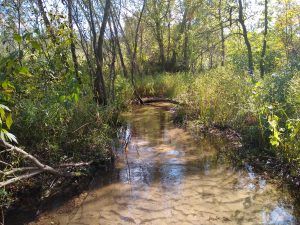
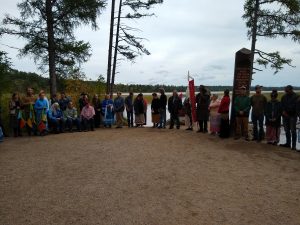 In September a prayer gathering was organized by Interfaith Power and Light, at the Mississippi Headwaters (Itasca State Park). I went to offer something Buddhist – the chant Enmei Jukku Kannon Gyo for protecting life. Here we are.
Last weekend I went to my teacher’s temple, gave a talk, talked with old friends, and did Zen practice with my old community. I came back with the thought that I need more zazen time. Two hours in the morning is more than twice as much as one hour. It’s time to settle down, become more quiet. And more time with the spirits of the land. I may do fewer events next year, even though the sense of urgency is stronger than ever.
When the world is falling apart – as is our shared human world, most of us – if we avoid the temptation of denial, if we choose to meet what is from the understanding of our place in the universe, our belonging to the family of life – well, that is my current question, and there are just inklings of how to move forward. One of these is to stay grounded, literally close to the earth. Another is that our human connections actually be human, not prescribed, rigid, machine-like, perfect, objectified, dead. Thus we are nourished; our decisions can be based on that awareness of belonging rather than on fear and isolation, or the need to control. That’s not even an outline; I’m working on it.
The Mushroom at the End of the World: on the possibility of life in capitalist ruins, by Anna Lowenhaupt Tsing – contemplations by an anthropologist that uproot many of my habitual thoughts about human interactions, economics, and the like.
Why Civil Resistance Works, by Erika Chenoweth – a convincing study, rather academic, by someone who really expected to find that violent resistance was more effective. Not just encouraging, but instructive in the how of activism.
If Women Rose Rooted: the journey to authenticity and belonging, by Sharon Blackie – not started yet, but looks enticing.
The events listing on the front page is easier to read than ever. But I’ll mention the first few:
Sunday October 20, 2-5 pm sitting meditation (walking and outdoor options) at the farm
Sunday October 20, 5:30-8:30 potluck. RSVP is quite important. We’ll listen to a talk by Sharon Blackie.
October 26-27, Introduction to Zen retreat (beginning with a short workshop on Saturday morning). This might be cancelled; I’d like at least four people. If interested contact me soon.
Leaves are starting to turn, and I turned on the heat for the first time this morning. It’s fall. A little late, but every extra warm day is another day to go outside, sweaters or no. I want to buy a splitting axe, a really good one from Lehman’s; someone suggested a GoFundMe for the $200. Thinking about it. What does heating with wood and splitting it myself have to do with the well-being of the world, the alliance with plants and animals and all beings? Only a matter of getting closer to the earth.
Love to you all,
Shodo

There’s a tricky thing about letting go of things. At the farm, mostly my attention is focused not on letting go but on things that are here that I don’t want – pocket gophers, Japanese beetles (new this year), buckthorn, black walnuts, quackgrass, honeysuckle…. As I write now, I remember that it’s really about losing things – losing orchard trees and potatoes, losing raspberries and tomatoes, losing flowers and the other native plants displaced by these… yet in my mind it still feels like having to accept that those others are here. And I’m working with it.
Looking at the black walnut trees everywhere, I’m starting to let go. I’d meant to confine them to their present one-acre territory and remove them elsewhere. There are too many; I would be in endless war; there must be a way to coexist. They are, after all, native, medicinal plants, high-quality food, and source of many other things used by humans. This year, I’ve started harvesting nuts and will actually follow through and eat them. Fall or spring, tapping for the sweet sap, alongside the regular tapping of box elder and maple. And tend them as lumber, to grow straight and tall. All this is looking for a way out of hate or victimization – the two modes I know the best. Is this exploitation or co-existence? And how, likewise, do we learn to have relationships with difficult people? Work with them somehow, negotiate, even team with them? I’ve had to do it before in communities and workplaces, when necessary. This with the walnuts and others is also necessary; can I find the heart to do it? (If I can work together with the walnuts, might I possibly work together with difficult humans? Suddenly the walnuts seem easy. I don’t ascribe intention to them.)
On the other side – things have changed, mostly for the better – or let me say, it’s mostly in ways that I like. The land care retreat, which felt like a new beginning at the time, seems to actually have begun some changes. People are coming for sesshin regularly. I had three weeks of house guests who practiced sincerely, worked mindfully and joyfully, and made sangha. “I could live this way,” I thought once near the middle of that time. And toward the end we began a practice of reading together, discussing, and then sitting until bedtime, which meets my needs for sangha in another way. Now I’m alone again, looking toward the weekend and the next sesshin.
We’re harvesting tomatoes, zucchini, herbs, raspberries, and the first walnuts. We planted several small sugar maple trees near the driveway, intending to make a grove for sugaring ten or twenty years in the future. There are more small maples to plant after removing the piles of firewood and weeds in that area. We could add the larger, faster maples that grow here like weeds and do produce some sap; I don’t know yet.
The nine trees I planted this spring – pear, apple, nut pine, and cherry – are all doing well, except one has lost its leaves already. The orchard is in neglect, and I hope to visit and prune while fall weather holds.
And yesterday we cleared an area near the back door, moving, burning, digging, making space for the firewood spaces that Chris is building against the barn. It’s like housecleaning – I can breathe more easily now.
Listening to a Public Radio show about melting ice in the Arctic, I note that more and more I’m hearing climate change in mainstream news. Now that it’s probably too late. I recommend this article: “What if we stopped pretending?” about the realities of climate change. What some of us are thinking about is how to act compassionately, ethically, and for the best possible outcomes, in a time when the bad news is so powerful and the forces destroying the planet are stronger and louder than ever. It feels like a war, and I haven’t figured out what to do except spiritual practice. I’m reading the book Why Civil Resistance Works (Chenoweth and Stephan), heavily researched, showing why nonviolent resistance is generally more successful than violent resistance, with no guarantees either way. Hopefully that will be helpful in some way.
Study/Action:
I almost forgot to mention – The Global Climate Strike includes actions around the world. This is one of those “everybody show up” occasions. Look for what’s in your area and find a way to get yourself there.
This morning, instead of sitting in the new zendo, I went to the central altar and sat by the creek and bluff for a while. It was easy in this new-fall weather, yet that reminds me that it won’t be easy long. My practice now is to be present with what is, not dislike the coming cold.
My feeling about winter is perhaps something like my feeling about climate change – about losing the regular movement of the seasons, about possibly being hungry – and that is from my very privileged position in a location where there’s been little change. Here, I prepare for refugees, not for floods and wildfires. Yet our vulnerability is much more clear since last fall’s tornado. “Not to get rid of things, but to accept that they go away.”
I was talking yesterday with a Dharma brother, and the topic of medicine came up. Neither of us normally goes to doctors. But for him it’s a matter of accepting that life moves along, not trying to fight aging. I fight aging like mad, just not with conventional medicine. Listening to him humbles me. Equanimity makes life better. Is it just because I’ve committed to engage with the protection of the world around me, that I attach to my own body? Or is my engagement a reflection of my personal attachment? I’ll watch that question for a while, not expecting an easy answer.
September 14, workday – clearing tangled spaces, moving firewood to make room for sugar maples, and more, depending on weather and number of people. If weather keeps us indoors, we might make comfrey salve, crack walnuts, play with woodworking, or clean the masonry heater and build the first fire. It’s fine to come for part of the day or all, 9-5 total.
And see this page for the next few things. Below are the “special” ones.
October 26-27: Introduction to Zen retreat
November 24, Sunday morning talk at NBMC by Courtney Work, an anthropologist studying Buddhism in rural Cambodia. I can’t say enough how excited I am about this.
November 30-December 5, Rohatsu sesshin (Saturday 7 pm – Thursday 3 pm)
Thank you to donors. You know who you are. This month’s new donation supports transcription of my past talks, which will help me publish a book. All options are here, including the way to support us for free.
With love,
Shodo